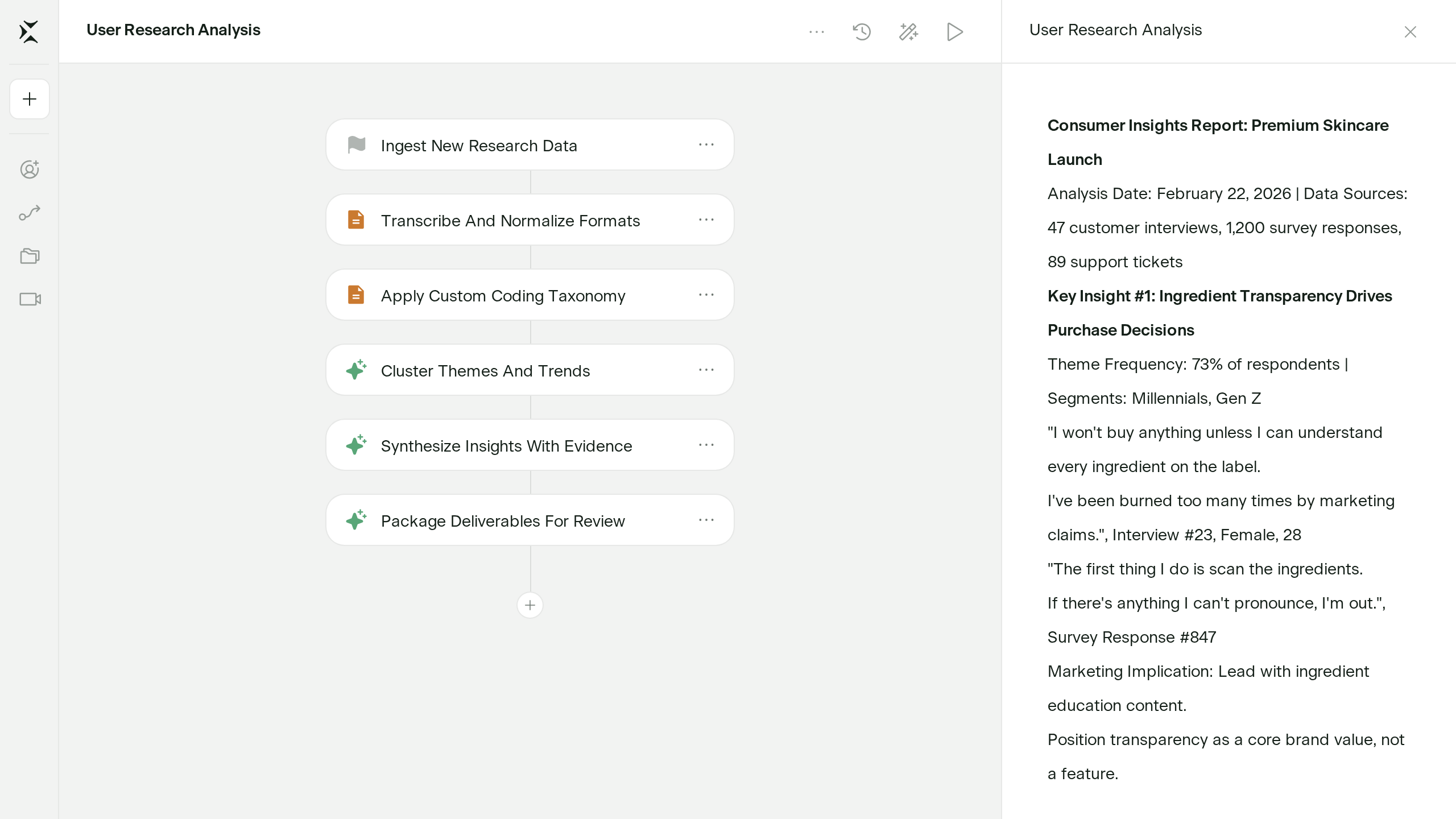
How Cassidy automates user research analysis using AI
Step 1: Trigger on new research data
The Workflow activates when new VoC data arrives—whether from uploaded interview transcripts, survey exports, CRM ticket feeds, call recordings, or social listening connectors.
Step 2: Transcribe and normalize
Cassidy transcribes audio and video, standardizes formats across sources, detects and redacts PII, and enriches each record with metadata like source, segment, funnel stage, and language.
Step 3: Apply coding taxonomy
The Workflow applies your custom coding schema—tagging for need states, pains, motivations, objections, JTBD, and journey stages—while flagging low-confidence codes for human review.
Step 4: Cluster and surface themes
Cassidy runs semantic clustering to group related codes into themes, quantifies frequency and trends across segments, and identifies contradictions or outliers that require triangulation.
Step 5: Synthesize insights with evidence
The agent generates atomic insight nuggets, each linked to supporting verbatims and timestamps, then drafts marketing implications—positioning territories, messaging hierarchies, and creative angles.
Step 6: Package deliverables
Cassidy compiles findings into structured outputs: insight decks, persona cards, journey maps, and experiment backlogs—ready for stakeholder review with full traceability to source data.
Implement this automation inside your company
- Hands-on onboarding and support
- Self-paced training for your team
- Dedicated implementation experts
- Ongoing use case discovery
- ROI tracking & analytics dashboards
- Proven playbooks to get started fast